Nomads and Nomad Polities
“Nomads and Nomad Polities”
 Whoever studies North Africa is puzzled by the presence of the Roman and Islamic Empires and the seemingly amorphous polities beyond them; meaning the regions of what is now Algeria and Morocco. Seemingly, only a few were organized by the Empires. Most of them formed their own polities. They developed distinct structures, as well as political and religious outlooks. These polities, as far as we can identify them, were formed by nomadic and semi-sedentary groups, which were called collectively ‘Berber’ in the Islamic period. Their history is mostly known from the perspective of the narrative (Arabic) sources of the Empires. Different forms first of Romanization and Christianization, afterwards of Islamication and Islamization during this state building processes took place, uncontrolled by the Empires.
In the wake of urbanization, particularly in western Maghrib, outside Africa Proconsularis and Ifrīqiya, the local nomadic groups also created urban centers. This is, especially, evident in the case of the Islamic period.
The two lectures of our general topic “Nomads and Nomad Polities” follow up questions raised by these polities, their adaptions and responses to imperial forms.
Nomads, Empires and the (Non-)Formation of Nomadic „States“ in Roman and Byzantine North Africa (1st to 6th c.) by Dr. Daniel Syrbe (Fernuniversität Hagen)
The authors of literary texts dealing with Roman and Byzantine North Africa, mostly regard nomads as people living at a particularly primitive stage of civilization. As a consequence, Roman and Byzantine historiography tends to repeat the narrative of interrelations between nomads and sedentary people as a story of continuous conflict and violence. In contrast, modern anthropological and geographical research interprets nomadism as a specific form of social and economic adaptation to the environmental conditions of arid regions. Using these models as a hermeneutic tool, a close reading of Roman and Byzantine literary texts in combination with surviving epigraphic and archeological material reveals the social and political dynamics of constructing communities in nomadic contexts in North Africa of the 1st to 6th centuries. Despite regional differences, it becomes clear that nomads were an integral part of life in Roman and Byzantine North Africa, closely connected to imperial institutions and mechanisms of social authority and political power. Following this approach, this presentation aims, in a first step, to trace the close mutual integration of nomadic and sedentary societies in Roman and Byzantine North Africa. In a second step, it attempts to suggest an answer to the question of why nomadic groups in Roman and Byzantine North Africa (unlike in Islamic times) did not establish larger, more or less stable state-like structures.
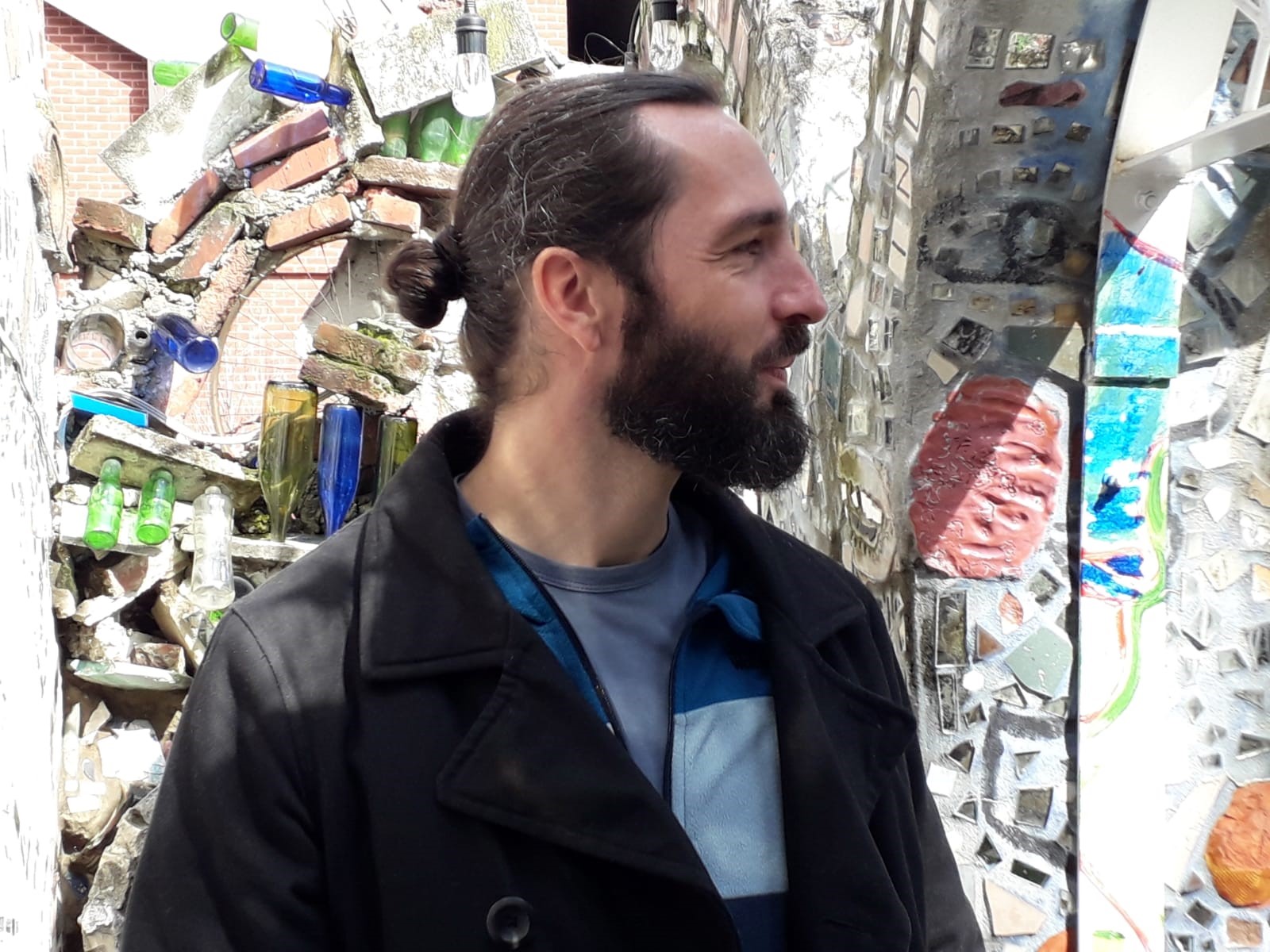
Dr. Daniel Syrbe are in the field of the political and cultural transition between antiquity and the middle ages. He studied ancient history and archaeology at the Universities of Leipzig and Cologne in Germany and the University of Leiden in the Netherlands. In his PhD thesis he analyzed interrelations between nomadic and sedentary populations in Roman and Byzantine North Africa (3rd to 6th c. CE). Later he moved on to the Danube, continuing his research at the “Leibniz Institute for the History and Culture of Eastern Europe (GWZO)” in Leipzig (GER). As part of an interdisciplinary research group of historians and archaeologists he studied central places and the Christianization of the Danube region in late antiquity and the early middle ages. From 2017 to 2020 he was part of the NWO-funded research group “Constraints and Tradition. Roman Power in changing societies (50 BCW to 560 CE)” at Radboud University in Nijmegen (NL), working on the influence of cultural traditions on political communication in the late Roman and early Byzantine Empire. Supported by a fellowship of the DFG Center foor Advanced Studies „Migration and Mobility“ at the University of Tübingen (2024/5), he currently works on a project on the Alani and the Caucasus Region in Antiquity ad the Middle Ages which brings him back to nomadic worlds again.
Des Maures aux Berbères: représentations textuelles et processus d'intégration à l'Islam d'Occident (VIIe-Xe siècle) by Prof. Dr. Allaoua Amara (Université Émir Abdelkader de Constantine, Algeria)
Une lecture critique des sources arabes sur les débuts de l’Islam au Maghreb est proposée afin de dégager les premières représentations des populations présentes au Maghreb au moment des conquêtes omeyyades. De la disparation du terme Maures à la généralisation du vocable Barbar, il est important de revenir sur le processus de bérbérisation dans le contexte maghrébin au début de l’islam. Sont à mettre en lumière les premières catégorisations de ces populations et le processus d’islamisation et d’acculturation qui aboutissent à la diversité de l’Islam maghrébin avant une malikisation intense dès la fin du Xe siècle.
 Allaoua Amara est professeur d’histoire de l’Islam d’Occident médiéval à l’Université Émir Abdelkader de Constantine et chercheur associé au CIHAM –UMR CNRS 5648 (Lyon) et au Laboratoire Islam médiéval- Orient et Méditerranée UMR 8167 (Paris). Ses recherches portent sur l’histoire des Berbères, l’islamisation et les transformations socio-culturelles au Maghreb médiéval. Il est l’auteur de nombreux travaux sur l’histoire de l’Islam d’Occident et les manuscrits arabes, dont le dernier est la coédition d’un corpus sur les inscriptions arabes de Tlemcen médiéval intitulé Tuḥfat al-i‘tibār fīmā wuğida min al-āṯār bi-madīnat al-ğidār.